Showing posts with label fashion. Show all posts

Thursday, May 6, 2010

Mother-daughter walk


On a school-vacation day last Friday, Lucinda and I went for a stroll from Sendagi to Nezu, two shitamachi (old neighborhoods) near Ueno Park. The nabes Yanaka, Nezu and Sendagi, known together as "Yanesen," have narrow streets with traditional shops and houses. Early May is also the perfect time to see the blaze of azaleas at Nezu Shrine.

I edited a story about shitamachi for the Japanese arts/culture magazine Kateigaho International Edition, which has a wonderful map in the current issue (cover below) to mark shops and restaurants that preserve the culture of "old Edo," as Tokyo was known from the 1600s to late 1800s.


Some snaps of our day, starting with Sendagi's famous paper store, Isetatsu, where you find samurai prints from the Edo period.


This senbei shop sells large, square rice crackers (modern senbei are round)...


...coated with green tea, sugar or soy sauce. Individual crackers are 60 yen (66 cents) and this package was 780 yen ($8.50).


Geta (wooden sandals) in a shop window:


Storefront selling candied imo, or sweet potatoes. The noren curtain (it's orange for this shop but more often navy or black) is displayed when a restaurant is open for business.


This shop, with buckets, cutting boards, and benches, had an intense menthol-like scent from the Japanese cedar or sugi.


We ate lunch on the grounds of Nezu Shrine, which was hosting a festival for thousands of seasonal visitors. Large torii gate at the entrance...


...leads to long path of tiny torii gates inside...


... which leads to the blazing hillside of azaleas (also shown in 1st foto of this post).


It's a short walk from the shrine to Nezu station, and along the way, we stopped at a tiny candy store (also mentioned in Kateigaho) that makes long rolls of ame (hard candies) with traditional Edo-style faces inside.


The rolls are sliced into discs, like these, that half-melt in your mouth. This package of 8 was 210 yen ($2.50) which I thought was a bargain for Edo craftsmanship. Not sure how this is done, but pretty cool-looking, neh?

Sunday, April 11, 2010

Wow!


Fashion disaster or triumph? A human sakura (cherry blossom) in Shinjuku Gyoen station, April 2010.

Sunday, March 28, 2010

Colors of Sakura


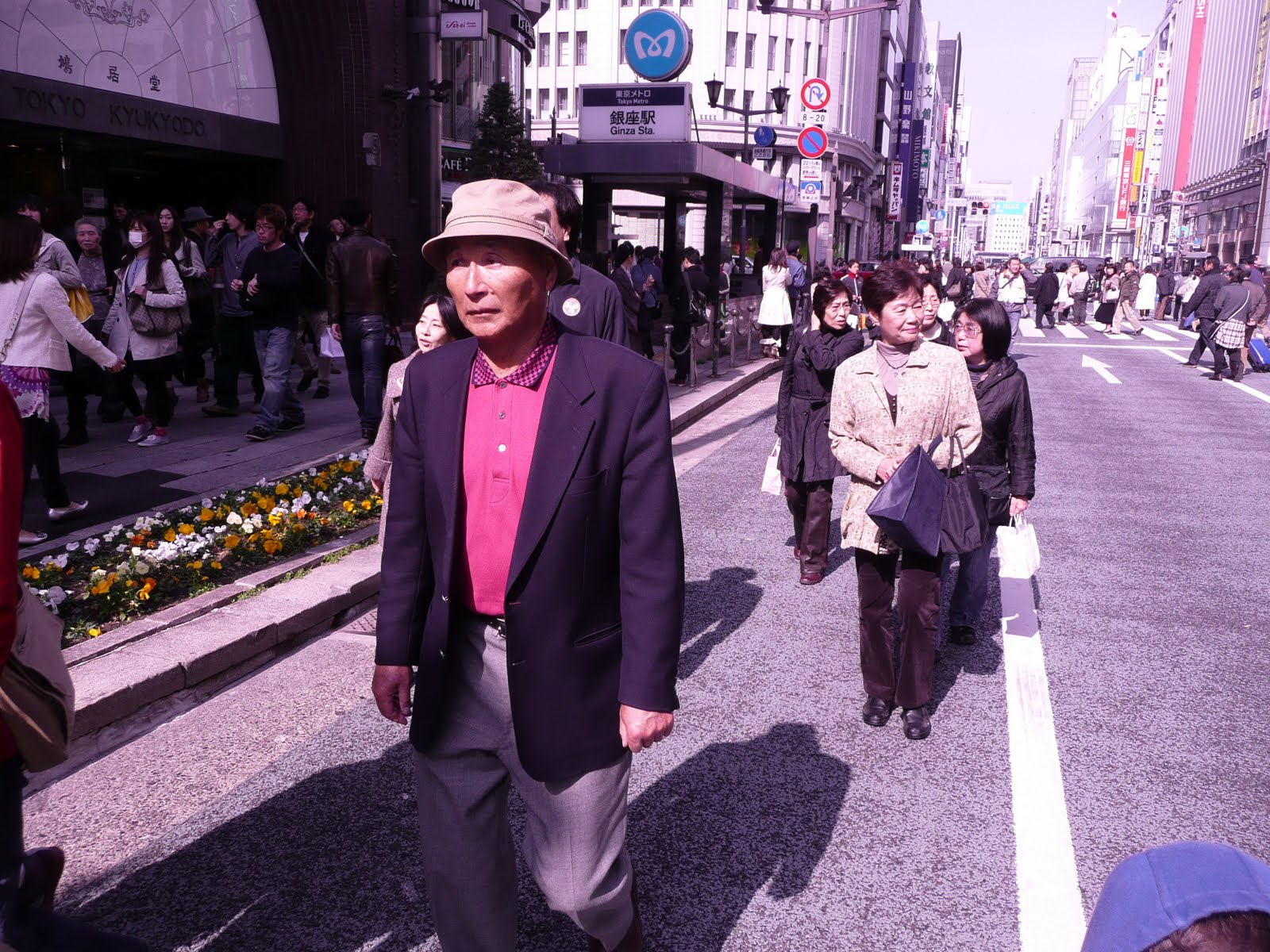
The cherry blossoms (sakura) are here again - and so, too, is the fashion season when women, men and children accessorize in shades of pink and raspberry, a cheerful sight after the coldest months. I noticed this a few years ago but it took a while to play Bill Cunningham and collect enough decent photos to show it properly. (It's harder than it looks to take pix of people who are walking and talking in crowds.)

Last Monday, a national holiday, Ginza's streets were pedestrian catwalks.


This incredibly slender woman (who would have been a perfect photo for Blaine's story about thin Japanese women) had a Vuitton bag and pashmina.


Spring shoes:


Wrapped chopsticks at the famous Kyukyodo paper store:


Older man:


Young girl:


A classic pose: cellphone messaging


A few more, to prove the point:


And finally, a flash of pink on an ice-cream vending machine.

Thursday, February 4, 2010

Polished

Curious machine: an automated shoe polisher in the subway station at Marunouchi, the banking district. 100 yen ($1) for 2 shoes, black or brown.

Wednesday, February 3, 2010

Minky

I saw a small dog wearing a mink coat today outside a grocery store. It looked like real mink. It's pretty chilly here - but mink for a dog?

Sadly, I didn't have my camera.

Saturday, December 5, 2009

La vida loca


Proving again that our expat life is la-la land, Blaine and I went to a black-tie "casino night" benefit last (Friday) night, the first time Blaine has worn a tuxedo since our 2002 wedding. The photo could be better, but, hey, it's evidence!

We were guests of some Tokyo-Seattle friends whose company paid for the table at the Westin Tokyo in Ebisu. After supper, I had a superfun spin at the benefit blackjack tables, especially after Blaine arrived to end a long streak of losing hands. I'm the second pile of orange chips from the right - worth about $7.


I've never gambled for real, and I'm clueless about the odds of this or any other game. Fortunately, there was a very bossy, busty American party guest at the table who claimed that she'd been a dealer in Louisiana. (Alas, no photo.) Somewhat drunkenly, but not irrationally, she repeatedly overruled me and everyone else about when to "hit" or not - and she was right most of the time. I more than tripled my $30 in chips by 10:30pm, when we flaked out and bet it all on a losing hand before hopping in a taxi to go home.

Monday, September 28, 2009

Antique obi


One thing that distinguishes Tokyo from US and even European cities is that centuries-old traditions co-exist with modern life. That was certainly true in the Ningyocho neighborhood near the Imperial Palace, where traditional shops are mixed in with office buildings -- and where these ladies-who-lunch (above) were walking around in kimono, geta sandals and white socks.

My first stop (on a tour arranged by the Tokyo American Club) was a corner workshop where an artisan made lacquered, woven boxes for kimono and obi storage. This is the entire operation; the artisan, who was painting the inside of a box-top, sat on the floor and hung boxes on ceiling hooks to dry.


Most boxes had a symbol (like the chrysanthemum) or some Japanese kanji characters on them; I didn't have a chance to ask what anything meant, but here's a close-up view.


Next I spotted a store selling individually forged scissors and other sharp items.


Then we walked to a nondescript office building with kimono and obi for sale on the 2nd and 3rd floor. The variety was overwhelming, but I was drawn to the antique obi, which were defined as "at least 50 years old." They're quite heavy and embroidered on both sides with silk thread. I bought the one on the left, with flowers (chrysanthemum, cherry, others) and fans; hopefully not a completely ridiculous purchase.


Close-up view, below center. The saleswoman said it was probably a wedding obi. It's about 15 feet long - seems impossible to wrap and tie around a tiny Japanese woman. People drape them on decorative hangers for display.


There were also some "story obi," helpfully labeled in English with prices...


... and thousands of cheaper polyester kimono with pastel flowers. I wasn't too keen on them.


Odd Egyptian pattern.


And a strange boar statue to finish the day.

Monday, August 31, 2009

Rainy day


For a big rainstorm yesterday, Lucinda and Arno were kitted out in Japanese style yesterday, with Hello Kitty and Shinkansen raincoats and ubiquitous clear-plastic umbrellas.

Saturday, August 22, 2009

Summer festival


Friday night was our third time going to the annual Noryo Matsuri, or Summer Festival, in Azabu Juban, and it's definitely less exotic than it was for us in 2007, when we were fresh off the plane, or last year, when we were more excited about surfing along in the crowds. Having said that, here are some new favorite photos from our evening.

Above, one of my favorite photos from Japan, because it's hard to capture the artificiality of Japanese fashion.

Lucinda and Arno dressed for the occasion:


Kimonos and crowds:


Shown from the back, a fan tucked into a sash (obi) holding a man's yukata (cotton kimono) together. The fan is printed with this year's festival poster design.


And fruit with a colorful candy coating, cooling on a huge block of ice. Friends of Lucinda and Arno bought some and found, to their disappointment, that their fruits were ume, or sour plums. (Top left in photo)


After a long walk home, Lucinda declared that she doesn't want to go next year because she played three games of chance and was rewarded only with the cheapest and worst toys.