Showing posts with label Japanese History. Show all posts

Wednesday, November 4, 2009

Temples and leaves in Nikko


This - my third post about our weekend in the mountains - covers our visit to Nikko, the historic capital of Japan's "Shogun" period captured by James Clavell. The original shogun, Ieyasu Tokugawa (1542-1616), who is buried here, is said to have "unified" the country in 1603, when he was named "Seii-taishogun," or "great generalissimo." (All of my historical info, btw, comes from the Nikko Tourist Association's website, which also has very reliable travel info and suggestions for short or longer walks in the area.)

We arrived in Nikko on this old-style train, which has red velvet seats. Two train lines go to Nikko: the JR (Japan Rail) line and the private Tobu line, and each has its own train station a few blocks apart. Does not seem like the best use of public land...


The Tobu train station has a Vermont-ish style.


After 1.5 hrs on 2 trains from Nasu-shiobara to Nikko, I thought it would be a good idea to to walk uphill through the town to reach the major shrines, instead of taking a bus. Um, bad idea. Arno was so unhappy - and his whining made me furious! This captures the moment perfectly.


I bribed Arno to keep walking by promising a piece of chocolate at the top of the hill. On the way, we found that Nikko is packed with old-world Japanese houses and temples, including one with a Volvo parked outside and another high on a hill.


The first "must-see" sight is the red-lacquered Shinkyo (Sacred Bridge) over the Daiya River. For centuries, only the emperor could cross it; now anyone can pay about 400 yen to stand on it. The bridge and river are lovely, but a busy intersection nearby lessens the romance.


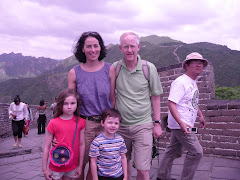
Nearby, up some mossy stone stairs, is the Rinnoji Temple complex. A huge temple - but we skipped it, on the advice of our Frommer's guidebook, to stroll in the gorgeous Syouyoen Japanese garden that was constructed centuries ago. Its Japanese maples were at peak color and the children loved skipping on stone paths and bridges. The family photo at the top of this post was taken there, and here's another shot.


Dozens of massive koi swim in the pond, and fish food is available in small bamboo containers, shown here, for 30 yen. The fish were not hungry, though.


Next up, the Toshogu Shrine, where Tokugawa-sama is buried. The structures decorated with gold leaf were impressive, but we marveled at the massive cedar trees encircling the shrine, which were actually planted here centuries ago. In this photo, see how tiny the people are compared to the huge stone torii gate at the entrance to the shrine complex - and the trees tower over that.


After you buy tickets, you walk by the "sacred stable," which allegedly houses a white horse (unseen by us). The stable's carving includes the famous "three monkeys" of "hear no evil, see no evil, speak no evil" fame. Which is a commentary on childhood innocence, blah, blah.


The monkeys:


To enter the shrine, a crowd waited to walk thru the Yomeimon gate, which has 500 sculptures...


...including samurai guards on either side.


Once inside, we looked it over and were suitably impressed - especially about the trees!


We didn't stay long because we had to catch a train to reach our hotel. We returned to the Shinkyo Bridge, ran for a bus, and reached the train station just in time. Congratulations all around after a sometimes-trying day of sightseeing and choco-bribery.

If this sounds like a good trip for you, there are several other sightseeing stops in Nikko, including Lake Chuzenji, the Kegon and Ryuzu waterfalls, and neat-looking hikes in the Senjogahara marshlands. Our kids are not old enough, or maybe willing enough, to deal w/that now. Maybe another time.

Friday, October 24, 2008

The sumo stable


The magazine that I help edit, Kateigaho International Edition, gave me my first writing assignment in Japan: 800 words about the experience of watching sumo for the first time.

I spent several hours a week ago at Kokonoe-beya, a famous sumo "stable". It was fascinating, slightly bizarre and very eye-opening. I've watched it on TV and assumed it was an odd sport. But the sumo guy I interviewed described it instead as a battle in which, he said, you want to "rip your opponent's head off."

We (me, my translator, a Japanese writer and 2 photographers) watched six young guys train for about an hour on the ground floor of the modern building where they also eat, sleep and live. This is what it looked like outside.


And inside the ground floor training/viewing room.


They train 7 days a week. Wearing only loin cloths and sometimes a bit of tape on toes or fingers, they face off dozens of times - losing repeatedly to stronger, bigger men. They are like football players, except that they don't have helmets or any physical protection; there's a good chance they'll wind up face down in the dirt or even with a broken neck.

Most contests last only seconds and have few rules. The two men face each other inside a rice-straw circle, called a dohyo. They touch their hands down on opposing white lines in the center before charging upward at each other. You lose if any part of your body, other than your feet, touches the ground or if you are forced out of the circle.


After each man was exhausted in the ring (among other training exercises), they did a bunch of sumo stomps, in which they lift and extend each leg at about 120 degrees. They are heavyset and sometimes even quite fat - but also shockingly strong and flexible.


At the end of their training, they did some stretches.


Finally, the wrestlers swept the clay floor with twig brooms and wiped down the walls, window sills and every surface in the room. They turned out the lights, leaving natural light for this lovely photo.


We went outside where the wrestlers were hanging out, barefoot, in the street.


I interviewed an articulate 23-yr-old guy, Chiyoshuhou, who's been at it for 5 yrs; he's still an amateur and he is paid a $250 monthly allowance in return for total 24-7 commitment. He described each sumo clash as "a minor car accident." It's terrifying, he said, so the stable master tells them, "You have to force yourself forward."


The wrestlers did their own laundry and dried it on the roof. Here are their loin cloths, which turn out to be about 20 feet long.


Later, I was invited to try their lunch. They eat twice a day and consume enormous quantities of sumo's special "Chanko" stew (made that day with pork, noodles, tofu, vegetables and miso broth), rice, grilled fish, fish eggs, squid, tea, more rice and more rice. Not a protein shake in sight!


Here's what I ate: rice, the stew (which was particularly delicious) and chewy sauteed squid with a brown sauce.


After lunch, in order of seniority, the wrestlers' long hair was combed into fresh topknots by the stable's hairdresser (top photo). The hairdresser combs grease into the hair with a very unusual comb and ties it with a string held in his teeth (middle photo) and folds it over. His implements are in the third photo.


After the hair ritual was finished, the men did the dishes, cleaned the kitchen and dining room, and went upstairs for a long nap in their tatami-matted room. Long naps, I was told, help them get fat.


It was a superfun day of reporting.

Sunday, May 25, 2008

Old Edo

On a recent day off from school, Lucinda and I went with our friends Laurie and Sylvan Lebrun to a museum that recreates scenes from "old Edo," as Tokyo was called from 1457 to 1868.

The Fukagawa Edo Museum, which is an old-style neighborhood, is very modern on the outside - a typically enormous concrete structure.


But inside there's a reconstructed, 19th-century riverside neighborhood. Here's a drawing of the concept and what you find after paying an entrance fee of 300 yen ($3) for adults and 50 yen (50 cents) for children.


There were a few elderly Japanese who worked, or volunteered, in the museum, sort of like greeters at Wal-Mart. One woman silently followed us around - like a "minder" in a Communist country - to make sure that Lucinda and Sylvan (two very responsible kindergarteners) didn't wreck anything. But an elderly man, who spoke very good English, more generously explained what we were looking at. (Forgive the dim pix; the light in the museum changed day-to-night-to-day, etc., also somewhat annoying.)

Edo neighborhoods like this one were mainly occupied by young, single laborers or married men whose wives were in the country. The names of the inhabitants are listed on a board above the gate leading to a small boarding house and other dwellings, as a security measure to keep strangers out.


In the boarding house, each laborer lived in a single room that was smaller than our current kitchen. The floors are tatami mats, the sleeping futons are folded in the corner (back left in the photo) during the day. Each has a tiny kitchen and a small portable table or tray to serve and eat on.


Sometimes there were rice-straw "raincoats" and hats hanging inside the door, and tiny sandals by the door.


There was a produce store (top) and a rice store (bottom), with big foot-levers to smash the rice into paste, or "mochi."


Also available for viewing: a water taxi to take laborers elsewhere to have a little fun, and a "fire tower" where residents would check for smoke every hour, because a moderate fire would wipe out the whole place in minutes. And a public square with a shack to sell "yakitori" or grilled seafood and veggies.


It was fun and interesting - if restrained. After our visit, we found a local restaurant for noodles, rice and tempura, and sat at traditional low-to-ground Japanese tables, very in-tune with our museum visit.