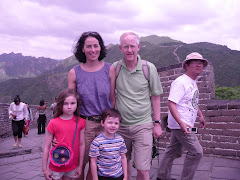
It's official: we're leaving Tokyo and moving back to Seattle on June 29. We've had a terrific 3 years here -- an excellent family adventure, with great friends, schools and restaurants! -- and it's time to return to "normal" life with a car, backyard and wild salmon on the bbq.
Next projects: Blaine is leaving The Washington Post and will write his third book, "Escape from Camp 14," about a young man who was born in the North Korean gulag and escaped when he was in his early 20s. I'll start looking for work. And Lucinda and Arno will join the ranks at the Seattle public schools.
I've been lax about posting on this blog in recent months, after (1) my computer broke, (2) my camera broke, and (3) as I've been more focused on trying to get a job that would keep us in Japan. (Despite best efforts -- and a lot of support and help from friends -- my job prospects here did not pan out.)
I'll try to post some photos, at least, of some of the sights we've seen in Asia that didn't see daylight yet. Thanks for reading my blog!
Showing posts with label Lucinda. Show all posts
Showing posts with label Lucinda. Show all posts
Thursday, June 17, 2010


Thursday, May 13, 2010
Wordle
Lucinda just introduced me to this neat website, Wordle at wordle.net.
You copy or input large blocks of text to create a "word cloud" that ranks how often the word is used in the story.
We created a Wordle using the text from Romeo and Juliet, and this is what it looks like.
You copy or input large blocks of text to create a "word cloud" that ranks how often the word is used in the story.
We created a Wordle using the text from Romeo and Juliet, and this is what it looks like.
Thursday, May 6, 2010
Mother-daughter walk

On a school-vacation day last Friday, Lucinda and I went for a stroll from Sendagi to Nezu, two shitamachi (old neighborhoods) near Ueno Park. The nabes Yanaka, Nezu and Sendagi, known together as "Yanesen," have narrow streets with traditional shops and houses. Early May is also the perfect time to see the blaze of azaleas at Nezu Shrine.
I edited a story about shitamachi for the Japanese arts/culture magazine Kateigaho International Edition, which has a wonderful map in the current issue (cover below) to mark shops and restaurants that preserve the culture of "old Edo," as Tokyo was known from the 1600s to late 1800s.

Some snaps of our day, starting with Sendagi's famous paper store, Isetatsu, where you find samurai prints from the Edo period.

This senbei shop sells large, square rice crackers (modern senbei are round)...

...coated with green tea, sugar or soy sauce. Individual crackers are 60 yen (66 cents) and this package was 780 yen ($8.50).

Geta (wooden sandals) in a shop window:

Storefront selling candied imo, or sweet potatoes. The noren curtain (it's orange for this shop but more often navy or black) is displayed when a restaurant is open for business.

This shop, with buckets, cutting boards, and benches, had an intense menthol-like scent from the Japanese cedar or sugi.

We ate lunch on the grounds of Nezu Shrine, which was hosting a festival for thousands of seasonal visitors. Large torii gate at the entrance...

...leads to long path of tiny torii gates inside...

... which leads to the blazing hillside of azaleas (also shown in 1st foto of this post).

It's a short walk from the shrine to Nezu station, and along the way, we stopped at a tiny candy store (also mentioned in Kateigaho) that makes long rolls of ame (hard candies) with traditional Edo-style faces inside.

The rolls are sliced into discs, like these, that half-melt in your mouth. This package of 8 was 210 yen ($2.50) which I thought was a bargain for Edo craftsmanship. Not sure how this is done, but pretty cool-looking, neh?

Wednesday, April 21, 2010
Progress
A red-letter day in the Tokyo American Club swimming pool, as Arno bravely pushed off from the wall this afternoon and swam about 5 feet to me! A first, after months of swim lessons last year and 2 lessons this spring. Then he swam across the lap lane about 40 times. Very exciting!
Lucinda, meanwhile, says TAC's Mini-Mudsharks swim team is "likable" - much more likable, in fact, than expected because I signed her up without asking. She has 3 smooth, relatively efficient strokes so far (butterfly is TK) and likes swimming on the clock. L has so far not enjoyed games with hard-to-identify rules and strategy (like soccer), but she seems to enjoy the self-directed, self-control of swimming - and maybe running? We'll see what develops.
Lucinda types: "I LOVE SWIMMING ALOT!"
Lucinda, meanwhile, says TAC's Mini-Mudsharks swim team is "likable" - much more likable, in fact, than expected because I signed her up without asking. She has 3 smooth, relatively efficient strokes so far (butterfly is TK) and likes swimming on the clock. L has so far not enjoyed games with hard-to-identify rules and strategy (like soccer), but she seems to enjoy the self-directed, self-control of swimming - and maybe running? We'll see what develops.
Lucinda types: "I LOVE SWIMMING ALOT!"
Friday, April 9, 2010
Spring flowers

I already wrote about sakura (cherry blossom) fashion. Now here are some snaps from our annual picnics (hanami) under the cherries.
Last weekend, the peak of the flower experience, we went to Shinjuku Gyoen, a huge, well-kept park near Shinjuku station, with many families from Arno's school, Willowbrook. Crowds lined up outside the gates to get in.

Blaine took this gorgeous shot that expresses the pure hanami experience of picnicking beneath the boughs.

Arno took charge of my camera and delivered this self-portrait...

... and a shot of his parents. I am drinking a can of hot green tea purchased from a vending machine.

Lucinda and Arno

The finale to this year's hanami was in Kinuta Koen (Kinuta Park) in Sendagaya-ku, Tokyo, at the Willowbrook spring picnic. Amazing trees!

An elegantly dressed older lady brought out to gaze at the blossoms.

And Arno's Take/Takenoko (Bamboo/Bamboo shoots) class this year.

Happy spring!
Wednesday, April 7, 2010
Our Pippi

Lucinda as Pippi Longstocking for Nishimachi Int'l School's annual Book Parade, held today.
Friday, February 26, 2010
Year of the Tiger

Lucinda, Arno and I went to Yokohama's Chinatown last weekend to see the Chinese New Year festivities. Lots of fun. To kick off the post, here's video of a dragon dance in the parade.
Snapshots: The gate to Chinatown

Roasted chestnuts for sale. Lucinda loves them, and Arno tried them (very rare development) and liked them!

An old traditional house on the main street.

A dog, sitting in a stroller and wearing a dress with a denim skirt. (You have to look closely, but it's definitely a skirt.)

Lucinda, wearing a dress purchased by her grandparents in Beijing, and Arno, in a Chinese devil mask; in Japanese, it's called an "oni."

Lunch for sale: heaps of pork (I think).

Lucinda's lunch: a steamed meat bun from a street stall for 200 yen ($2).

Chinese children led the parade with dragon puppets.

The emperor, who spoke very good English when he wished the children "Happy New Year."

Another creature came over to greet us.

On to the rest of the Year of the Tiger!

Wednesday, February 17, 2010
Snowy morning

We had a treat this morning: actual feathery snow falling as we walked to school. Very rare in our Tokyo experience.
Saturday, February 13, 2010
Night out

Blaine and Lucinda went to the Father-Daughter dinner dance at the Tokyo American Club last night.
Friday, January 29, 2010
Nishimachi's birthday
Lucinda's school, Nishimachi International School, is celebrating its 60th anniversary. It was founded by an American-educated Japanese woman, Tane Matsukata, in 1949, to build understanding between people by, in part, having all students study English and Japanese.
I went to a cocktail party tonight (on Founder's Day, which is Tane Matsukata's birthday) and snapped some archival photos on display.
From the 1950s.

From the 1960s, dancing around the maypole in front of the Matsukata family home, which was built in the early 1900s and survived the war. Now it's the recently earthquake-proofed admin building.

From the 1970s, Miss Matsukata and students.

Lucinda's kindergarten class in 2007-8. Lucinda is in the second row behind Rhen, the boy in the blue shirt. Compare this photo to the 1950s one; the school has fulfilled the goal of selecting students from many nations.

I went to a cocktail party tonight (on Founder's Day, which is Tane Matsukata's birthday) and snapped some archival photos on display.
From the 1950s.

From the 1960s, dancing around the maypole in front of the Matsukata family home, which was built in the early 1900s and survived the war. Now it's the recently earthquake-proofed admin building.

From the 1970s, Miss Matsukata and students.

Lucinda's kindergarten class in 2007-8. Lucinda is in the second row behind Rhen, the boy in the blue shirt. Compare this photo to the 1950s one; the school has fulfilled the goal of selecting students from many nations.

Thursday, January 14, 2010
Hong Island

Thailand has fantastic diving near Krabi, and you can take a longtail boat to famously beautiful islands like Ko Phi Phi or James Bond Island to see fish. When we considered day trips, though - with Lucinda, a good swimmer, and Arno, who can't swim and is fully capable of whining his way through the most delightful scenery - we decided to take a much easier snorkeling trip to Ko Hong (Hong Island).
We hired a longtail boat for about 1200 baht (33 baht = $1, so that's about $40 for the day), including lunch. Our captain, who said his name was Jack, met us after breakfast.

We arrived at Ko Hong a half-hour later, the second boat to anchor - and the beach was almost empty (see top photo and below).

Lucinda, almost always willing to try new things, enjoyed snorkeling; Arno was predictably a bit anxious about the novelty but enjoyed looking for shells on the beach. Then some beer-drinking Germans (beer at 10 a.m.!) gave us some slices of bread to feed colorful fish who swarmed around us in a frenzy.


A little later, we walked into the island's interior and learned, by way of wooden boats flung 100 meters into the jungle, that Ko Hong was slammed by the 2004 tsunami, causing some deaths and injuries. (Here's one person's account of it.) There hadn't been any tsunami damage at our hotel or in Ao Nang, as (I think) that slice of shoreline was protected by Phuket, to the west.

Ko Hong has a neat geology: limestone formations that make the rock look like dripping candle wax.

After lunch, when it was high tide, "Captain Jack" took us around to the other side of the island to see its lagoon. Quite beautiful views, as you float through the narrow entrance.


The water was very warm and only a few feet deep over flat, soft sand. So Lucinda, Arno (buck-naked by that point) and I climbed out of the boat and walked around.


It was an easy adventure, without being too much adventure, for everyone.
Subscribe to:
Posts (Atom)