We're on a 5-day family tourist trip to Beijing!
Staying at the Grand Hyatt with a very reasonable rate from Expedia. Seeing the highlights. Last 36 hrs: hutong neighborhood and houses, dim sum, Peking Duck, stuffed pandas supplied by hotel.
Today, Great Wall. Last night, amazing acrobat show. Next few days: Tiananmen, Forbidden City, Temple of Heaven and maybe a few other things.
Photos to come. But it's v exciting for all of us to be here.
Saturday, May 22, 2010


Thursday, May 13, 2010
Wordle
Lucinda just introduced me to this neat website, Wordle at wordle.net.
You copy or input large blocks of text to create a "word cloud" that ranks how often the word is used in the story.
We created a Wordle using the text from Romeo and Juliet, and this is what it looks like.
You copy or input large blocks of text to create a "word cloud" that ranks how often the word is used in the story.
We created a Wordle using the text from Romeo and Juliet, and this is what it looks like.
Thursday, May 6, 2010
Mother-daughter walk

On a school-vacation day last Friday, Lucinda and I went for a stroll from Sendagi to Nezu, two shitamachi (old neighborhoods) near Ueno Park. The nabes Yanaka, Nezu and Sendagi, known together as "Yanesen," have narrow streets with traditional shops and houses. Early May is also the perfect time to see the blaze of azaleas at Nezu Shrine.
I edited a story about shitamachi for the Japanese arts/culture magazine Kateigaho International Edition, which has a wonderful map in the current issue (cover below) to mark shops and restaurants that preserve the culture of "old Edo," as Tokyo was known from the 1600s to late 1800s.

Some snaps of our day, starting with Sendagi's famous paper store, Isetatsu, where you find samurai prints from the Edo period.

This senbei shop sells large, square rice crackers (modern senbei are round)...

...coated with green tea, sugar or soy sauce. Individual crackers are 60 yen (66 cents) and this package was 780 yen ($8.50).

Geta (wooden sandals) in a shop window:

Storefront selling candied imo, or sweet potatoes. The noren curtain (it's orange for this shop but more often navy or black) is displayed when a restaurant is open for business.

This shop, with buckets, cutting boards, and benches, had an intense menthol-like scent from the Japanese cedar or sugi.

We ate lunch on the grounds of Nezu Shrine, which was hosting a festival for thousands of seasonal visitors. Large torii gate at the entrance...

...leads to long path of tiny torii gates inside...

... which leads to the blazing hillside of azaleas (also shown in 1st foto of this post).

It's a short walk from the shrine to Nezu station, and along the way, we stopped at a tiny candy store (also mentioned in Kateigaho) that makes long rolls of ame (hard candies) with traditional Edo-style faces inside.

The rolls are sliced into discs, like these, that half-melt in your mouth. This package of 8 was 210 yen ($2.50) which I thought was a bargain for Edo craftsmanship. Not sure how this is done, but pretty cool-looking, neh?

Monday, April 26, 2010
Trailing spouse: Philippines and Thailand edition
Blaine has 2 months left as the Post's Tokyo bureau chief but he can't slack off! He's been in the Philippines for 9 days and was scheduled to return tonight, but has now been sent on to Thailand to cover the govt unrest there.
Alas, we were looking forward to his return tonight and to family activities during the upcoming "Golden Week" holiday in Japan. Come home soon, Blaine!
Alas, we were looking forward to his return tonight and to family activities during the upcoming "Golden Week" holiday in Japan. Come home soon, Blaine!
Blaine's latest...
... is another great story about the Philippines at election time.
This country generates so many sad stories: it exports its workers (including many women to Tokyo as domestic "helpers," whose children stay in the Philippines) and fails to make progress on social improvements and infrastructure. Here's the top:
In Philippines, pre-vote largess doesn't translate into post-vote progress
By Blaine Harden
Tuesday, April 27, 2010
MANILA -- It's election season in the Philippines, and the short-term forecast is for manna from heaven.
For voters who live in Baseco, a slum built on garbage beside Manila Bay, it's hard to keep track of all the incoming goodies. Roads have been paved. Playgrounds have been built. A maternity clinic is under construction. One candidate bankrolled a beauty contest. Another sent in doctors bearing free antibiotics. Demolition of squatters' huts has been halted. Free food is expected on May 10, election day.
"It is like a fiesta," said Ray Campanera, senior councilor in the local government here. "Life is a little bit happier."
Yet for the residents of Baseco, as for the poor who account for a third of the 92 million people in the Philippines, pre-election good times are almost always followed by post-election betrayal.
Politicians who win election in this former U.S. colony have one of the worst records in Southeast Asia for stiffing the poor, coddling the rich and indulging themselves, according to a mountain of data and a chorus of economists....
This country generates so many sad stories: it exports its workers (including many women to Tokyo as domestic "helpers," whose children stay in the Philippines) and fails to make progress on social improvements and infrastructure. Here's the top:
In Philippines, pre-vote largess doesn't translate into post-vote progress
By Blaine Harden
Tuesday, April 27, 2010
MANILA -- It's election season in the Philippines, and the short-term forecast is for manna from heaven.
For voters who live in Baseco, a slum built on garbage beside Manila Bay, it's hard to keep track of all the incoming goodies. Roads have been paved. Playgrounds have been built. A maternity clinic is under construction. One candidate bankrolled a beauty contest. Another sent in doctors bearing free antibiotics. Demolition of squatters' huts has been halted. Free food is expected on May 10, election day.
"It is like a fiesta," said Ray Campanera, senior councilor in the local government here. "Life is a little bit happier."
Yet for the residents of Baseco, as for the poor who account for a third of the 92 million people in the Philippines, pre-election good times are almost always followed by post-election betrayal.
Politicians who win election in this former U.S. colony have one of the worst records in Southeast Asia for stiffing the poor, coddling the rich and indulging themselves, according to a mountain of data and a chorus of economists....
Friday, April 23, 2010
Blaine's latest...

... is an excellent read from the Philippines about the corpse of Ferdinand Marcos!
Here's the top:
Late Philippine dictator Ferdinand Marcos makes cameo in busy campaign season
By Blaine Harden
Thursday, April 22, 2010
BATAC, PHILIPPINES -- The waxy-looking corpse of Ferdinand Marcos, dead almost 21 years and chilling in a refrigerated glass coffin here in his home town, has joined the Philippine political circus.
In the chaotic run-up to national elections May 10, about 85,000 candidates are clamoring after 17,000 positions, from town council member to president. Political violence has claimed at least 80 lives, including 57 in one incident. And families that have long called the shots in the Philippines are angling for advantage.
That's why the body of the former president is putting in a publicity-grabbing campaign cameo, with the careful contrivance of his widow, Imelda. The former first lady -- who became infamous for her many fancy shoes and whose first name became a synonym for greed -- is 80 and is once again running for political office, along with her son, her daughter and a sizable gaggle of lesser Marcos kin...
Wednesday, April 21, 2010
Progress
A red-letter day in the Tokyo American Club swimming pool, as Arno bravely pushed off from the wall this afternoon and swam about 5 feet to me! A first, after months of swim lessons last year and 2 lessons this spring. Then he swam across the lap lane about 40 times. Very exciting!
Lucinda, meanwhile, says TAC's Mini-Mudsharks swim team is "likable" - much more likable, in fact, than expected because I signed her up without asking. She has 3 smooth, relatively efficient strokes so far (butterfly is TK) and likes swimming on the clock. L has so far not enjoyed games with hard-to-identify rules and strategy (like soccer), but she seems to enjoy the self-directed, self-control of swimming - and maybe running? We'll see what develops.
Lucinda types: "I LOVE SWIMMING ALOT!"
Lucinda, meanwhile, says TAC's Mini-Mudsharks swim team is "likable" - much more likable, in fact, than expected because I signed her up without asking. She has 3 smooth, relatively efficient strokes so far (butterfly is TK) and likes swimming on the clock. L has so far not enjoyed games with hard-to-identify rules and strategy (like soccer), but she seems to enjoy the self-directed, self-control of swimming - and maybe running? We'll see what develops.
Lucinda types: "I LOVE SWIMMING ALOT!"
Sunday, April 11, 2010
Wow!

Fashion disaster or triumph? A human sakura (cherry blossom) in Shinjuku Gyoen station, April 2010.
Friday, April 9, 2010
Spring flowers

I already wrote about sakura (cherry blossom) fashion. Now here are some snaps from our annual picnics (hanami) under the cherries.
Last weekend, the peak of the flower experience, we went to Shinjuku Gyoen, a huge, well-kept park near Shinjuku station, with many families from Arno's school, Willowbrook. Crowds lined up outside the gates to get in.

Blaine took this gorgeous shot that expresses the pure hanami experience of picnicking beneath the boughs.

Arno took charge of my camera and delivered this self-portrait...

... and a shot of his parents. I am drinking a can of hot green tea purchased from a vending machine.

Lucinda and Arno

The finale to this year's hanami was in Kinuta Koen (Kinuta Park) in Sendagaya-ku, Tokyo, at the Willowbrook spring picnic. Amazing trees!

An elegantly dressed older lady brought out to gaze at the blossoms.

And Arno's Take/Takenoko (Bamboo/Bamboo shoots) class this year.

Happy spring!
Wednesday, April 7, 2010
Our Pippi

Lucinda as Pippi Longstocking for Nishimachi Int'l School's annual Book Parade, held today.
Sunday, March 28, 2010
Blaine's latest...
... is a "Letter from Japan" about the men who use hammers to pound out the aluminum noses of shinkansen, the Japanese bullet trains. Lovely writing!
Headline: "A hammer -- yes, that low-tech tool -- helps mold noses of Japan's bullet trains"
Headline: "A hammer -- yes, that low-tech tool -- helps mold noses of Japan's bullet trains"
Colors of Sakura

The cherry blossoms (sakura) are here again - and so, too, is the fashion season when women, men and children accessorize in shades of pink and raspberry, a cheerful sight after the coldest months. I noticed this a few years ago but it took a while to play Bill Cunningham and collect enough decent photos to show it properly. (It's harder than it looks to take pix of people who are walking and talking in crowds.)
Last Monday, a national holiday, Ginza's streets were pedestrian catwalks.


This incredibly slender woman (who would have been a perfect photo for Blaine's story about thin Japanese women) had a Vuitton bag and pashmina.


Spring shoes:

Wrapped chopsticks at the famous Kyukyodo paper store:

Older man:
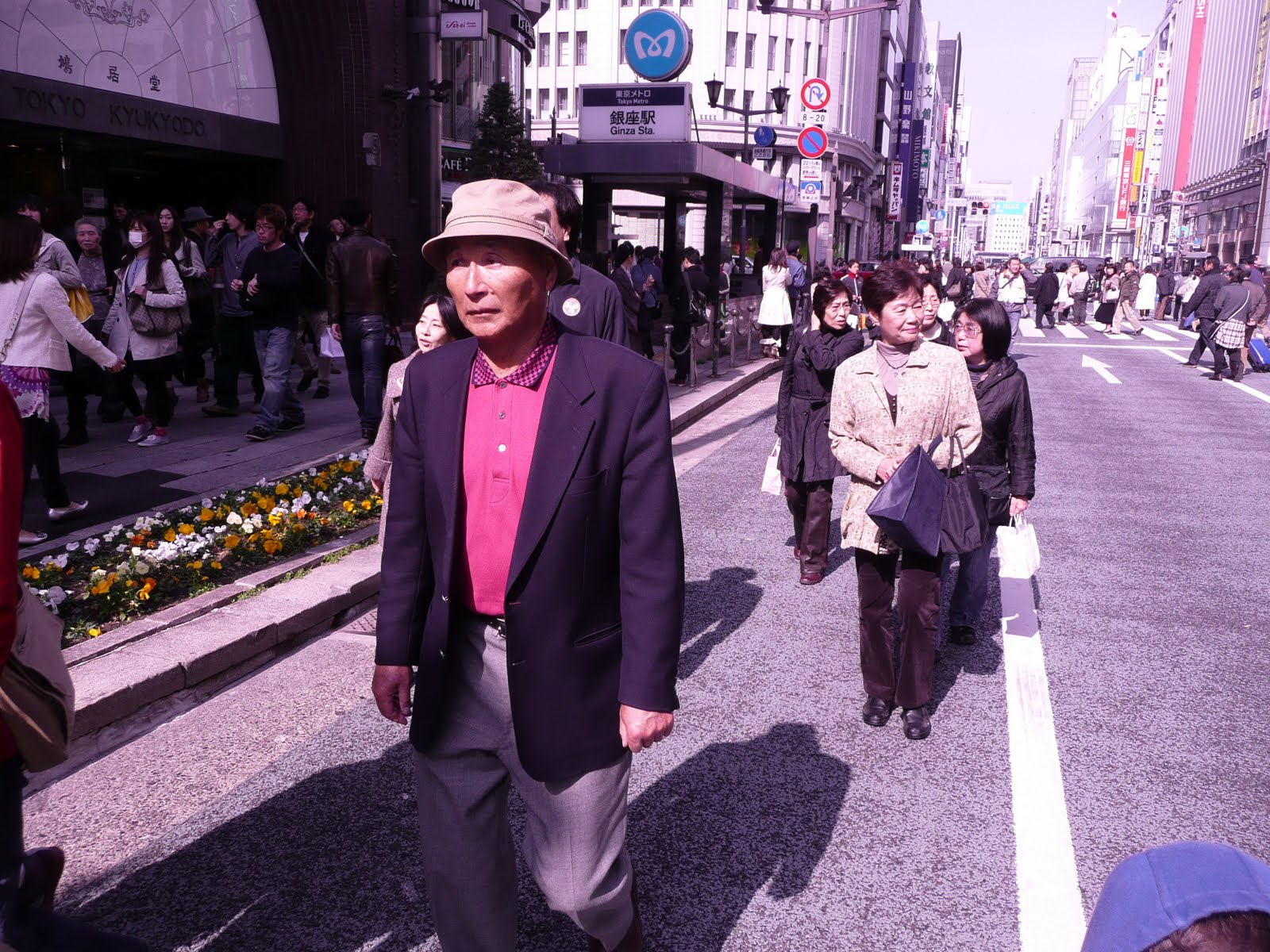
Young girl:

A classic pose: cellphone messaging

A few more, to prove the point:


And finally, a flash of pink on an ice-cream vending machine.

Monday, March 22, 2010
Blaine's latest...
... is a front-page story about the US military's redeployment to Guam, a US territory - and how bringing 79,000 people (mainly Marines and their families) to the island could severely damage the environment and sewer and water systems.
Among the highlights:
"Many families have members serving in the armed forces; among the 50 states and four territories, this island regularly ranks first in recruiting success. Guam's killed-in-action rate is about four times as high as on the mainland...
Led by the Marines, American forces liberated the island in 1944, and people here say they still feel a debt to the United States. To repay it, they proudly call their island the "tip of the spear" for projecting U.S. military power in the Far East...
"We don't mind being the tip of spear, but we don't want to get the shaft," said Simon A. Sanchez II, chairman of Guam's commission on public utilities.
Among the highlights:
"Many families have members serving in the armed forces; among the 50 states and four territories, this island regularly ranks first in recruiting success. Guam's killed-in-action rate is about four times as high as on the mainland...
Led by the Marines, American forces liberated the island in 1944, and people here say they still feel a debt to the United States. To repay it, they proudly call their island the "tip of the spear" for projecting U.S. military power in the Far East...
"We don't mind being the tip of spear, but we don't want to get the shaft," said Simon A. Sanchez II, chairman of Guam's commission on public utilities.
Wednesday, March 10, 2010
Friday, March 5, 2010
Blaine's latest...
are two stories about women and social pressures in Japan and South Korea.
This story looks at why Japanese women are so thin - and they are incredibly thin. While American women have gained weight - obesity has risen from 17 percent to 35 percent since 1980, Japanese women (other than those over age 70) have actually lost weight over the past 25 years.
If you go into most clothing stores here, even Banana Republic in expat-friendly Roppongi Hills, there aren't many items over a size 6 and size 0 is very common. (This, and the fact that almost everything is sized for shorter people, saves me heaps of time and money.) In the US, many women gain weight during pregnancy and never lose it, but several Japanese moms at Arno's or Lucinda's school have had babies and bounce back below 100 lbs within a few months.
But many women take thinness to scary levels; it's anecdotal, of course, but I've seen many more anorexic women here than I ever did in NYC.
Blaine's second story (which actually ran first) is about the difficulties of being a working mother in South Korea. One woman, a marketing executive with a 6-yr-old son, took out full-page newspaper advertisements to declare "I Am a Bad Woman" because she is sick of being criticized by her husband, son and mother-in-law for continuing to work.
The story includes this astonishing statistic: "South Korean law allows a full year of subsidized parental leave, but intense peer pressure at work means that working mothers usually take little time off, according to government surveys. Only about 35,000 parents in this country of 49 million people (my italics) took advantage of child-care leave subsidies last year."
It's fascinating to compare lifestyles in Japan and other countries we visit to the American way of life; every country has its own specific pathologies. In Japan, it's incredibly difficult for Japanese women to have full-time, high-powered jobs and also have children - in part because Japan's immigration laws don't allow them to hire lower-cost immigrants for childcare. (Expats with certain work visas can, by contrast, hire immigrants as nannies.) The Japanese also smoke much more than Americans do.
But it's impossible not to live here and not recognize that the U.S. has serious food issues. It's not just about obesity rates, but (I think) because the food industry creates and Americans accept a high-volume array of processed foods that have too much salt, sugar, fat and calories. In Japan, food is seasonal, served in much smaller but still filling portions and lacks the American corn-syrupy sweetness, even in chocolate. Arno recently took a small bite of a Milky Way that was leftover from Halloween, declared it was too sweet, didn't eat the rest.
This story looks at why Japanese women are so thin - and they are incredibly thin. While American women have gained weight - obesity has risen from 17 percent to 35 percent since 1980, Japanese women (other than those over age 70) have actually lost weight over the past 25 years.
If you go into most clothing stores here, even Banana Republic in expat-friendly Roppongi Hills, there aren't many items over a size 6 and size 0 is very common. (This, and the fact that almost everything is sized for shorter people, saves me heaps of time and money.) In the US, many women gain weight during pregnancy and never lose it, but several Japanese moms at Arno's or Lucinda's school have had babies and bounce back below 100 lbs within a few months.
But many women take thinness to scary levels; it's anecdotal, of course, but I've seen many more anorexic women here than I ever did in NYC.
Blaine's second story (which actually ran first) is about the difficulties of being a working mother in South Korea. One woman, a marketing executive with a 6-yr-old son, took out full-page newspaper advertisements to declare "I Am a Bad Woman" because she is sick of being criticized by her husband, son and mother-in-law for continuing to work.
The story includes this astonishing statistic: "South Korean law allows a full year of subsidized parental leave, but intense peer pressure at work means that working mothers usually take little time off, according to government surveys. Only about 35,000 parents in this country of 49 million people (my italics) took advantage of child-care leave subsidies last year."
It's fascinating to compare lifestyles in Japan and other countries we visit to the American way of life; every country has its own specific pathologies. In Japan, it's incredibly difficult for Japanese women to have full-time, high-powered jobs and also have children - in part because Japan's immigration laws don't allow them to hire lower-cost immigrants for childcare. (Expats with certain work visas can, by contrast, hire immigrants as nannies.) The Japanese also smoke much more than Americans do.
But it's impossible not to live here and not recognize that the U.S. has serious food issues. It's not just about obesity rates, but (I think) because the food industry creates and Americans accept a high-volume array of processed foods that have too much salt, sugar, fat and calories. In Japan, food is seasonal, served in much smaller but still filling portions and lacks the American corn-syrupy sweetness, even in chocolate. Arno recently took a small bite of a Milky Way that was leftover from Halloween, declared it was too sweet, didn't eat the rest.
Friday, February 26, 2010
Year of the Tiger

Lucinda, Arno and I went to Yokohama's Chinatown last weekend to see the Chinese New Year festivities. Lots of fun. To kick off the post, here's video of a dragon dance in the parade.
Snapshots: The gate to Chinatown

Roasted chestnuts for sale. Lucinda loves them, and Arno tried them (very rare development) and liked them!

An old traditional house on the main street.

A dog, sitting in a stroller and wearing a dress with a denim skirt. (You have to look closely, but it's definitely a skirt.)

Lucinda, wearing a dress purchased by her grandparents in Beijing, and Arno, in a Chinese devil mask; in Japanese, it's called an "oni."

Lunch for sale: heaps of pork (I think).

Lucinda's lunch: a steamed meat bun from a street stall for 200 yen ($2).

Chinese children led the parade with dragon puppets.

The emperor, who spoke very good English when he wished the children "Happy New Year."

Another creature came over to greet us.

On to the rest of the Year of the Tiger!

Subscribe to:
Posts (Atom)